Inverse Square Law
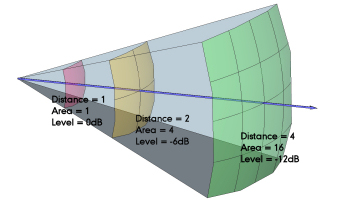
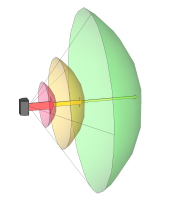
Any point source – for example, a standard point-source loudspeaker, whose sound energy propagates uniformly in all directions and is assumed to be infinite within the range under consideration for theoretical purposes – follows the inverse square law.
The intensity at a specific distance from the source – that is, at any radius R from the point of origin of the sound waves – corresponds to the source strength divided by the resulting surface area of the assumed sphere surrounding the source.
Point sources of gravity, electric fields, light or other forms of radiation also follow this law.
These conditions naturally only apply in a free field, i.e. without the influence of a developing diffuse sound field. Under real-world conditions in a room with an average reverberation time of approximately 1 second, the values are reduced by about half, as direct sound and diffuse sound mix. Consequently, for measured sound pressure levels in the room outside the critical distance and regardless of the time factor, one can assume a reduction of only 3 dB for every doubling of the distance.
|
|
|
The inverse-square law is a principle that expresses the way radiant energy propagates through space. The rule states that the power intensity per unit area from a point source, if the rays strike the surface at a right angle, varies inversely according to the square of the distance from the source. (Source: Whatis?com)
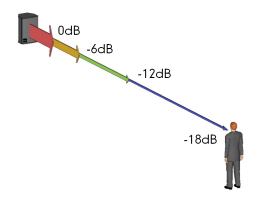
The sound pressure level diminishes inversely with the square of the distance from the source (as all other forces).
If the distances from the sound source are d1 and d2, then the difference Dd in dB at these points is:
Dd =
10 log
(d2/d1)2
= 20 log
(d2/d1)
 (feet or meters)
Sound radiation from a loudspeaker in a room
If you measure a loudspeaker on-axis using a sound level metre, you will obtain a specific value, e.g. 90 dB. This means that the loudspeaker produces a sound pressure level of 90 dB on-axis at the given distance. In this way, you can also measure the maximum sound pressure level at a distance of 1 metre or check whether the specification in the data sheet is correct. However, you are then operating at maximum output, which can be critical for both your hearing and the loudspeaker.
We will now assume that we carry out the following measurements within the critical distance, i.e. within the range where the direct sound is not masked by diffuse sound in the room. Otherwise, the result would be distorted and the measurements would not be very meaningful.
If we now compare two loudspeakers – for example, one with a dispersion angle of 40 x 20 degrees and another with a dispersion angle of 90 x 60 degrees – these two loudspeakers emit very different amounts of energy into the room, despite having the same measured sound pressure level on-axis. The sound energy emitted by a loudspeaker, in contrast to the sound pressure level, is considered to be omnidirectional radiation over a solid angle of 360 degrees in all axes around the loudspeaker. However, the sound pressure level – the value commonly used to evaluate a loudspeaker – is measured only along the main axis of radiation. A narrow dispersion angle, e.g. 40 × 20 degrees, means that a much larger proportion of the total energy emitted is focused on the main axis than, for example, with a loudspeaker having a dispersion angle of 90 × 60 degrees. The wider a loudspeaker’s dispersion angle, the more energy must be generated to achieve the specified value on the axis. The remaining sound energy is effectively emitted into the room more or less uncontrollably, bypassing the axis.
Things get extreme here with an omnidirectional loudspeaker, where the energy radiated along the main axis under consideration can only be relatively low compared to the total omnidirectional energy emitted (this is also the reason why omnidirectional loudspeakers only ever achieve relatively low SPL values, even though they emit the same total energy).
The specified sound pressure level therefore always includes an indication of direction, unless otherwise stated. For the general assessment of a loudspeaker, it makes no sense to measure the sound pressure level at ‘any’ angle. The results would no longer be comparable. However, comparing the total sound energy emitted by the loudspeaker certainly makes sense, as this value represents the loudspeaker’s total power consumption.
Ideally, therefore, one measures the longitudinal wave of sound propagation along the main axis of the loudspeaker. Air molecules oscillate mainly along the axis of sound radiation, from the loudspeaker to the measuring device. Of course, they do not actually move from the loudspeaker to the measuring device; rather, they oscillate back and forth to a greater or lesser extent, depending on the amount of energy with which the air molecules were originally set in motion directly at the loudspeaker diaphragm. During this longitudinal oscillation, air molecules repeatedly collide with neighbouring molecules, so that the information is transmitted as sound pressure in the direction of propagation.
Reverberation
In reverberation, unlike with a directional loudspeaker, thousands of reflections are generated in all directions, triggered by constantly repeating reflections off the room walls. With each new reflection, a new direction of propagation is added. Ultimately, the entire air mass vibrates diffusely in a jumble. This results in what is known as statistical reverberation, as there is no longer a preferred direction of propagation.
Consequently, however, the directional information provided by the radiation from the individual loudspeakers loses its relevance. Energy components (and directions of propagation) mix in a statistical and chaotic manner. The sum of all vibrations in all directions within the room is represented by the sound energy and no longer has any directional reference.
This sound field is best visualised as an energy field, represented at every point in space by isotropic sound energy – that is, air molecules vibrating in all directions, whose motion is generated by excitations from a wide variety of directions.
These varying conditions within the sound field also explain why music coming from a loudspeaker, even when combined with very beautiful reverberation, can never sound truly natural and spatial.
Classical instruments in particular, with their near-omnidirectional sound radiation, blend seamlessly into the diffuse energy field of the reverberation, thereby forming a sonic unity with the room. In contrast, a standard loudspeaker always emits a significantly higher level of sound energy along its defined radiation axis, compared with the total energy it radiates into the omnidirectional space. As a result of its design, the loudspeaker therefore always has a much more dominant radiation pattern and only blends into the overall diffuse sound field much further back in the room. This fact is also evident in the different approaches to the reverberation radius (omnidirectional) and critical distance (directional).
